

Your website traffic stalls even though you post content regularly, and you suspect Google just doesn’t understand your pages the way it should. That’s usually an on-page problem, not a content problem. On-page SEO services fix exactly this: the title tags, headings, internal links, image alt text, and page structure that tell search engines what a page is about and why it deserves to rank.
If you’re searching for on page seo services, you’re likely trying to figure out two things at once: who can actually do this work well, and what the work involves before you pay for it. Fair question. Good onpage seo services cover keyword mapping, content optimization, technical fixes like page speed and mobile usability, and schema markup, all applied page by page rather than as a generic checklist.
In this article, we break down exactly what on-page SEO includes, how agencies approach it step by step, and what results you should expect after implementation. We’ll also cover how to tell a thorough on-page audit from a surface-level one, based on what we’ve seen work for Chennai businesses competing in crowded local search results.
Why on-page SEO services matter for your rankings
Search engines can’t read a page the way a person does. They rely on signals like your title tag, header structure, keyword placement, and internal linking to figure out what a page covers and how well it answers a searcher’s question. Without these signals set up correctly, even genuinely useful content gets misread or ignored. This is the gap on-page SEO services close: they translate your content into a format search engines can accurately evaluate, which directly affects whether you show up for the searches your customers actually run.
What Google reads before it ranks you
Google’s crawlers scan specific elements on every page: the title tag, meta description, H1 and subheadings, image alt attributes, URL structure, and the actual body text. Each element carries weight. A page selling "gym equipment in Tambaram" but titled only "Home" gives Google nothing to work with, no matter how good the product descriptions are further down the page. Keyword placement in the right spots, paired with clear header hierarchy, tells Google exactly what the page is about and which queries it should match.

A page Google can’t understand is a page Google won’t rank, no matter how good the writing is.
On-page SEO vs off-page and technical SEO
Business owners often lump all SEO together, but on-page, off-page, and technical SEO solve different problems. Understanding where on-page fits helps you evaluate whether a provider is actually doing the work you’re paying for, or just running a generic "SEO package" that skips it.
| SEO type | What it covers | Example task |
|---|---|---|
| On-page SEO | Content and structure on your own pages | Optimizing title tags, headers, keyword placement |
| Off-page SEO | Signals from outside your website | Backlinks, citations, social mentions |
| Technical SEO | Site infrastructure and crawlability | Site speed, mobile rendering, XML sitemaps |
All three matter, but on-page work is where relevance gets established. You can have a fast site with strong backlinks, but if your pages don’t clearly signal what they’re about, you’ll still lose rankings to a competitor with weaker technical setup but sharper on-page structure.
What happens when on-page SEO is missing
Missing on-page optimization shows up in predictable ways. Pages rank for the wrong keywords, or don’t rank at all despite having decent content, which is exactly the situation SEO services in Chennai that fix low rankings are built to diagnose. Click-through rates stay low because meta descriptions don’t match what searchers are looking for. Bounce rates climb because visitors land on a page that doesn’t clearly address their query in the first few lines. None of these problems get fixed by publishing more content. They get fixed by restructuring what’s already there, which is the core job of onpage seo services.
Owners of small business sites often assume traffic problems mean they need more blog posts or more backlinks, though that’s rarely where the best SEO services for small businesses start. In our experience running audits for Chennai clients, the actual fix is usually simpler: rewrite three title tags, restructure two service pages, add internal links between related pages, and rankings shift within weeks. That’s a fraction of the effort of a full content overhaul, and it’s why on-page work tends to deliver the fastest visible return of any SEO activity.
Why it matters more for local businesses in Chennai
Local search results are crowded, and searchers in Chennai typically compare five or six businesses before picking one. When two competitors offer similar services, the one whose pages are structured for search, with location keywords in the right headers, service pages that match search intent, and schema markup that helps Google display rich results, wins the click. On-page work is also what supports your Google My Business optimization in Chennai and local map pack visibility, since Google cross-references your website content against your listed business information.
Regional businesses that skip on-page SEO in favor of paid ads alone often find themselves paying for traffic they could have earned organically. Fixing your on-page foundation reduces your long-term dependence on ad spend and builds rankings that keep working after the campaign budget runs out. That compounding effect, more than any single tactic, is why on-page SEO services remain one of the highest-value investments a small business can make in its website.
How on-page SEO services work: the optimization process
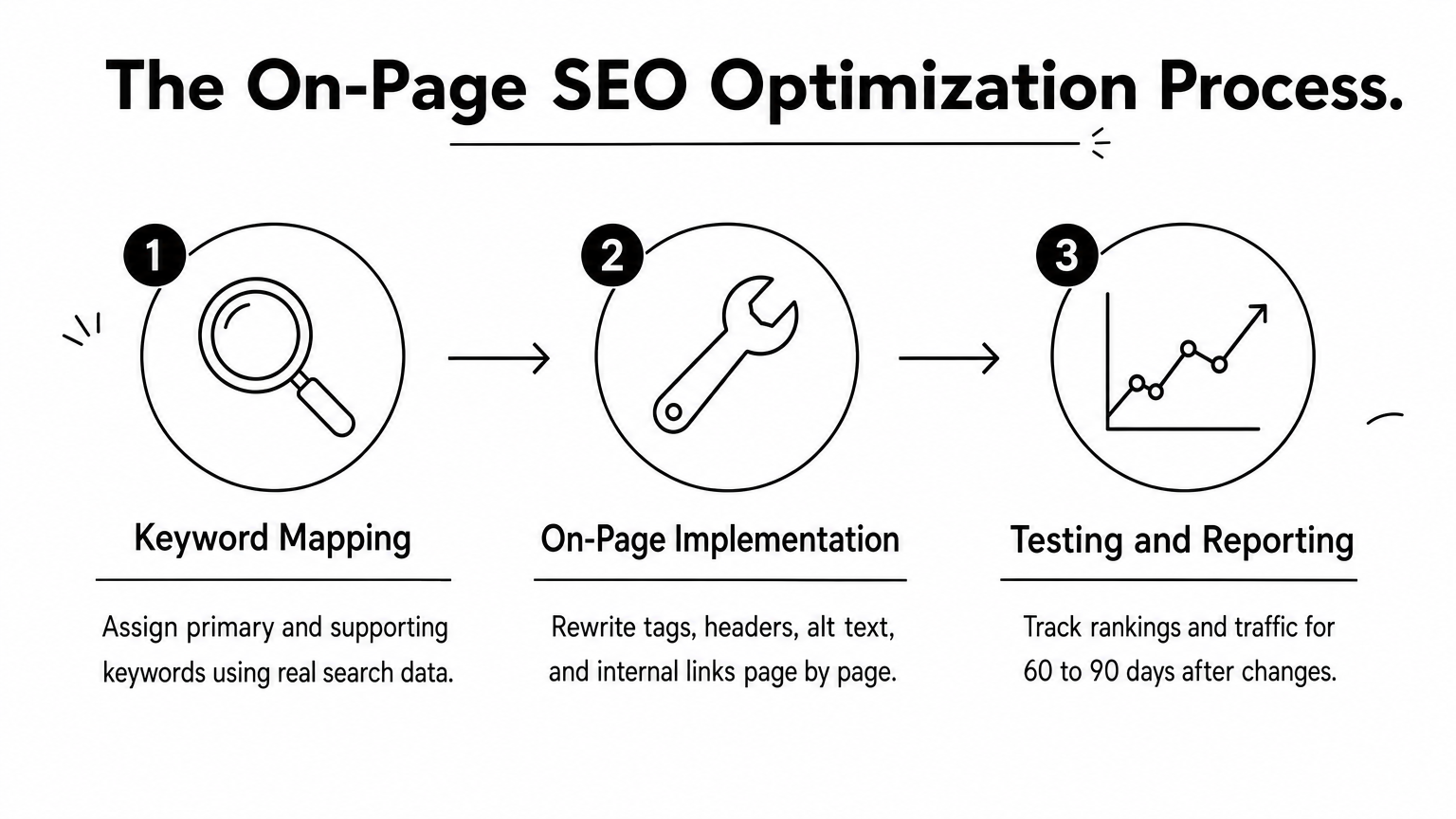
A proper on-page SEO engagement follows a sequence, not a checklist you tick randomly. Providers start with research, move into implementation, and finish with measurement, because skipping any step leaves you guessing whether the changes actually worked. Knowing this sequence helps you evaluate a proposal before you sign it, and it’s the same process our team at I Remote Digital Marketing Agency runs for every SEO project we take on.
Step 1: Keyword mapping and content audit
Every page gets assigned a primary keyword and two or three supporting terms based on actual search volume and intent, not guesswork. The audit phase also flags duplicate title tags, thin content, and pages competing against each other for the same keyword, a problem called cannibalization that quietly caps rankings for both pages involved. This mapping exercise is what separates real onpage seo services from a provider who just skims your homepage and calls it done.
Optimization without keyword mapping is just guessing with extra steps.
Step 2: On-page implementation
Once the mapping is set, the actual edits happen page by page. This is the technical, hands-on part of the work, and it typically includes:
- Rewriting title tags and meta descriptions to match search intent and include target keywords naturally
- Restructuring H1 and H2 headers so they follow a logical hierarchy Google can parse
- Adding descriptive alt text to images, which also helps with image search traffic
- Building internal links between related service pages and blog posts
- Compressing images and checking mobile rendering, since page speed still influences rankings
- Adding schema markup for local business, reviews, or FAQs where relevant
Each of these tasks sounds small individually, but combined across a 10-page website, they shift how Google interprets the entire site.
Step 3: Testing and reporting
Good providers don’t disappear after implementation. Rankings, organic traffic, and click-through rates get tracked for 60 to 90 days after changes go live, since search engine indexing doesn’t happen instantly and results build gradually. If a change doesn’t move the needle, an experienced provider revisits it rather than leaving it in place out of habit.
Reporting should be specific: which pages changed, what keywords moved, and what the traffic numbers looked like before and after. Vague monthly updates that just say "rankings improved" without page-level detail usually mean the provider isn’t tracking the work closely enough to prove it worked. Ask for this level of detail upfront, before you commit to a monthly retainer, so you’re not stuck waiting three months to find out the process was never really running.
What to look for in an on-page SEO service provider
Not every agency that advertises SEO actually does on-page work well, and the difference shows up months after you’ve paid an invoice, not before. Before you sign a contract, you want proof of process, not just a promise of results. The right way to choose the best agency for your business is to ask them to show you exactly how they’d approach your site, then judge the answer against what you now know a proper process looks like.
Ask for a sample audit before you commit
Any provider worth hiring should be willing to run a quick audit on two or three of your pages before you sign anything. This costs them almost nothing and tells you immediately whether they’re looking at your actual title tags, header structure, and keyword gaps, or just reciting a generic pitch. If a salesperson can’t point to specific problems on your specific pages within a short call, they haven’t done the homework, and they won’t do it after you’ve paid either.
If a provider can’t show you a problem on your own site, they can’t fix it either.
Check how they report progress
Transparent reporting separates providers who track their work from those who hope you don’t ask questions. Request a sample report from an existing client engagement, with names redacted if needed, and look for page-level detail rather than vague summaries. A provider tracking things properly should be able to show you:
- Which specific pages were changed and when
- Which keywords moved up, down, or stayed flat
- Organic traffic numbers before and after the change window
- What’s scheduled next and why
If the sample report only says something like "rankings trending positively," treat that as a warning sign rather than reassurance.
Look for experience with businesses like yours
A provider who’s optimized dozens of ecommerce product pages might not understand the nuances of a local service business competing in Chennai’s map pack results. Ask for case studies from your industry or a comparable local market, and ask specifically what changed and what the measurable outcome was. Vague claims like "we improved visibility" without numbers usually mean the provider doesn’t measure their own work closely enough to prove it worked, which should worry you more than a lack of case studies altogether.
Confirm they combine on-page with the rest of your SEO
On-page fixes matter most when they’re paired with clean technical SEO and a realistic off-page strategy, so ask how the provider handles the parts outside their core pitch. A provider offering only on-page tweaks while ignoring site speed or backlink quality is solving one-third of the problem and calling it complete. The strongest on-page SEO services come bundled with technical audits and ongoing content writing support, since isolated fixes without that context tend to plateau after the first round of changes. This is also where you should ask directly how they’d sequence work across your full site, since a provider without a clear answer likely doesn’t have a repeatable process at all.
On-page SEO services pricing: what to expect
The SEO services price in Chennai for on-page work typically starts around Rs. 7,999 per month for a small business site with 5 to 10 pages, and climbs from there based on page count, competition, and how much content needs rewriting versus restructuring. Agencies that quote a flat, unusually low rate for an entire site, regardless of size or industry, are usually running a templated checklist rather than page-specific work. Transparent pricing tied to actual scope is one of the clearest signs you’re dealing with a provider who understands the work, not just someone reselling a generic package.
What determines the price
Cost depends on how much work each page actually needs, not just how many pages exist on your site. A five-page site with clean content and a working structure costs less to optimize than a five-page site full of duplicate title tags and thin service descriptions, even though both sites are the same size. Competitive industries also push pricing higher, since ranking a gym in a crowded Chennai neighborhood takes more keyword research and content rework than ranking a niche B2B service with little direct competition. Ask any provider to explain their quote in terms of pages, hours, or specific deliverables, rather than accepting a round number with no breakdown behind it.
A price with no breakdown behind it is a price you can’t actually evaluate.
Typical pricing tiers in India
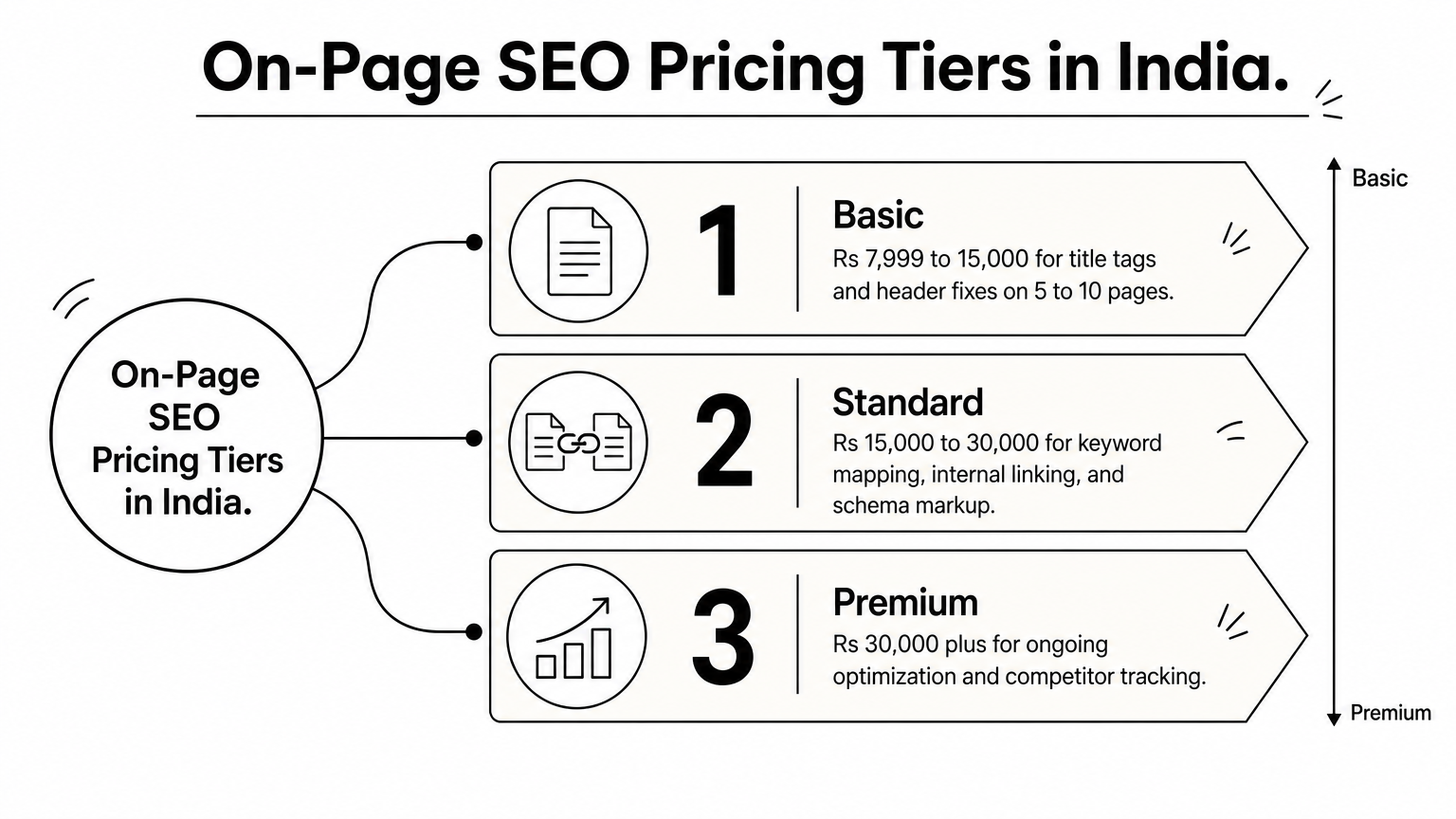
Most agencies structure onpage seo services into tiers based on site size and depth of work. Here’s a rough guide to what you should expect at each level:
| Tier | Monthly price range | What’s typically included |
|---|---|---|
| Basic | Rs. 7,999 to 15,000 | Title tags, meta descriptions, header fixes for 5 to 10 pages |
| Standard | Rs. 15,000 to 30,000 | Full keyword mapping, internal linking, schema markup, monthly reporting |
| Premium | Rs. 30,000+ | Ongoing optimization, content rewrites, competitor tracking, multi-location pages |
These ranges shift depending on the agency and your industry, but alongside the wider digital marketing pricing packages in India they give you a baseline to compare quotes against, rather than judging a number in isolation.
Watch for pricing red flags
Unusually cheap packages often hide unusually thin work, so treat rock-bottom quotes with the same skepticism you’d apply to an overpriced one. Before signing anything, check for these warning signs:
- A quote with no page count or deliverable list attached
- A single flat fee regardless of how many pages your site has
- No mention of reporting frequency or what metrics get tracked
- Pressure to sign a 12-month contract before seeing any sample work
Getting a quote that lists exact pages, deliverables, and reporting cadence upfront protects you from paying for work that never really happens. Our own SEO services start with a free consultation precisely so you can compare scope and pricing before committing to anything.
Putting on-page SEO to work for your business
Getting your rankings back on track rarely needs a content overhaul. It needs title tags that match what people search for, headers that follow a logical structure, and internal links that guide both visitors and Google through your site. Skip these fixes, and even your best content stays invisible to the searches that matter most.
Handled correctly, on-page SEO services deliver the fastest visible return of anything you can do on your website, precisely because the changes are targeted rather than sweeping. You now know what the process looks like, what a fair quote includes, and which red flags mean a provider is cutting corners.
If you’d rather have someone run this process for you than piece it together yourself, see how a top SEO agency in Chennai works and book a free audit for a clear scope before you spend a rupee.